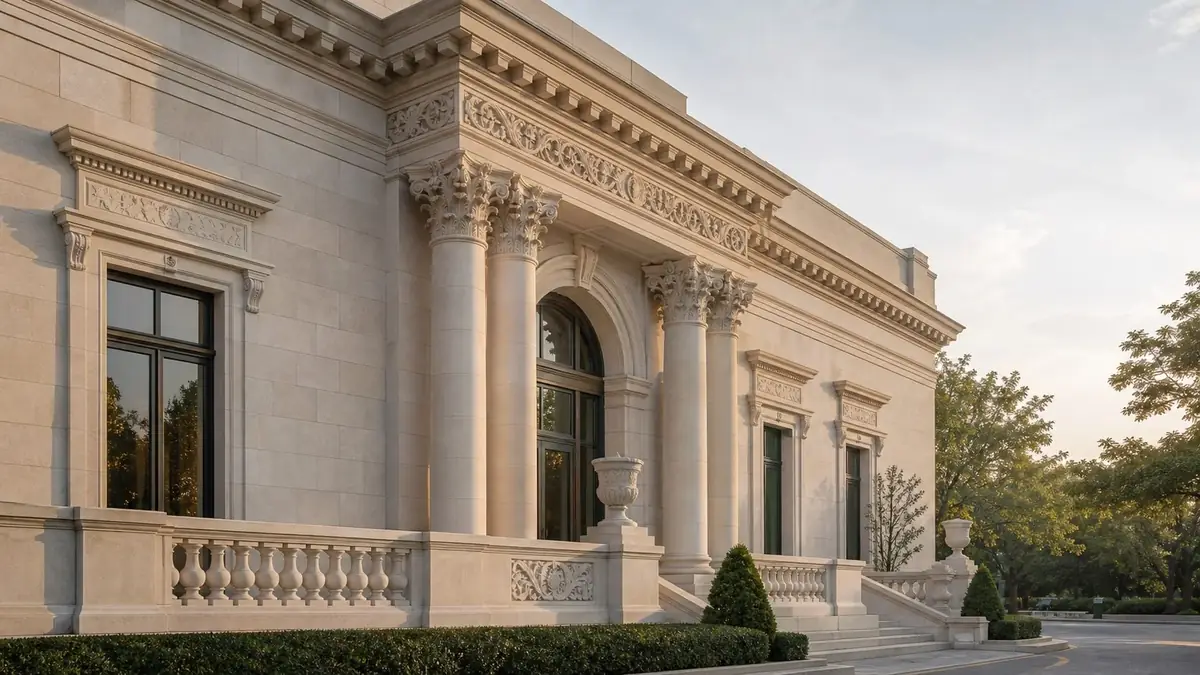
Natural stone fabrication guide
Custom Limestone Fabrication
Limestone is frequently selected where an architectural project needs warm colour, workable carving detail and coordinated components rather than flat commodity slabs. Suitability still depends on the specific quarry, bedding, exposure, section size, finish and performance requirements.
Material at a glance
How does Boda Stone work with this material?
Boda Stone fabricates custom limestone components from approved elevations, profiles, schedules, CAD files or 3D geometry. The production route can combine block selection, bridge cutting, profiling, CNC roughing, hand carving, finish control, piece marking and export packing.
Limestone is frequently selected where an architectural project needs warm colour, workable carving detail and coordinated components rather than flat commodity slabs. Suitability still depends on the specific quarry, bedding, exposure, section size, finish and performance requirements.
Project fit
Where the material is commonly considered.
Final suitability depends on the actual source, approved design, exposure and project evidence.
Columns, capitals and porticos
Cornices, mouldings and repeated profiles
Door and window surrounds
Church portals and architectural ornament
Curved and special-shaped components
Selection checks
Define the stone before releasing production.
- Confirm the exact quarry or approved visual range
- Review bedding orientation and natural variation
- Match section thickness to projections and handling
- Check climate, saturation and freeze-thaw exposure
- Define anchors, joints and interfaces with the local design team
- Agree samples and testing before production release
Available finish directions
Approve a representative surface.
Honed or matteFine rubbedSandblastedBush-hammeredTooled or combedCarved and hand-refined
Finish names can vary by market and supplier. The physical sample or approved reference should control the result.
Project evidence
Records that can connect approval with delivery.
The exact record set is agreed from project requirements rather than promised as a generic certificate package.
Approved control sample and range sample
Block or batch identification when specified
Dimensional and profile inspection
Finish and carving comparison records
Project-specific third-party test reports when arranged
Packing list, piece marks and crate references
Buyer questions
Answers before material approval.
Send the proposed stone, exposure, component dimensions and specification for a project-specific review.
Can exterior limestone components be made from CAD drawings?+
Yes. Elevations, sections, profiles and component schedules can be reviewed together. Complex radii or ornament may also require approved 3D geometry or a physical reference.
Is every limestone suitable for an exterior facade?+
No. The stone must be evaluated against exposure, climate, water movement, bedding, finish, section and the project's required test data. A familiar trade name alone is not enough.
How are repeated limestone profiles kept consistent?+
Approved profile data, machine templates or CNC geometry, first-piece approval, range checks and numbered inspection records are used according to the project scope.
Material review
Connect the stone with the actual geometry.
Send drawings, dimensions, finish, destination and any required test schedule. The first response will identify open material and production decisions.